
Where Pike County Crime News Appears
The Pike County Sheriff’s Crime Report archive is the most direct official channel for local incident news. It posts dated reports on a repeating schedule. Press releases, safety notices, and community posts appear there too. That pattern gives a useful picture of sheriff activity across a stretch of dates. It is not a live jail roster, though. It does not promise a booking photo in every entry or a full log of city arrests. Local journalism plays a different role. The Magnolia Gazette keeps a news section covering Pike County and Southwest Mississippi. The Enterprise-Journal is the main McComb-area paper named in city sources. Its site blocks direct access with a 403 error. Regional TV and online outlets round out coverage when an agency puts out information. None of them works as a daily Pike mugshot service.
Where crime news gets printed matters. Local outlets tend to publish arrest reports fast, often within a day of the booking. Stories about a Pike County arrest usually surface in regional papers and broadcast sites before the court file catches up.
Pike County News Outlet Directory
Every outlet on the list works differently. The sheriff channel comes first for a reason. It reports its own agency activity directly. Journalistic outlets may pull from agencies, court filings, witnesses, or other named sources. Captions and photo credits tell you what an image actually is. A story with a name and an agency-supplied picture is still not a full booking record.
| Outlet | Coverage and cadence | Photo context | Where to check |
|---|---|---|---|
| Pike County Sheriff Public Relations | Official, periodic countywide Crime Reports and announcements. | Some posts may have agency images, but no full photo policy was found. | Sheriff Crime Reports |
| Magnolia Gazette | Local Magnolia, county-seat, and Southwest Mississippi news. No dedicated arrest blotter was verified. | Article-specific and not a custody confirmation. | News section |
| Enterprise-Journal | McComb-area and Pike news. Research access was blocked, so current categories and cadence require a fresh check. | Historical reporting sometimes supplied images used by regional television. | Main site |
| WAPT and WLBT | Regional event-driven television coverage of selected Pike stories. | May use agency-supplied images, not a continuing booking feed. | WAPT example and WLBT example |
| Darkhorse Press and Mississippi News Group | Occasional regional or county coverage. | Article-specific sourcing and no stable Pike mugshot section. | Mississippi News Group Pike page |
Coverage here is event-driven. No outlet runs a verified daily arrest service. A quiet news day proves nothing about whether an arrest happened. By the same token, an old story proves nothing about who is in custody right now or what charge may still be pending.
Pike County Sheriff Crime Reports
Sheriff Crime Reports arrive in date windows. Examples from 2026 include January 9–15, January 23–29, February 27–March 5, March 6–12, and April 17–23. Community material and public-safety notices are mixed into the archive as well. The chronology makes these reports a solid official source for checking a reported event. Just do not expect a same-day booking feed. Coverage centers on sheriff cases and major incidents rather than every municipal or state arrest in the county.
The January 9–15, 2026 Crime Report shows the sheriff’s public-report format in action.
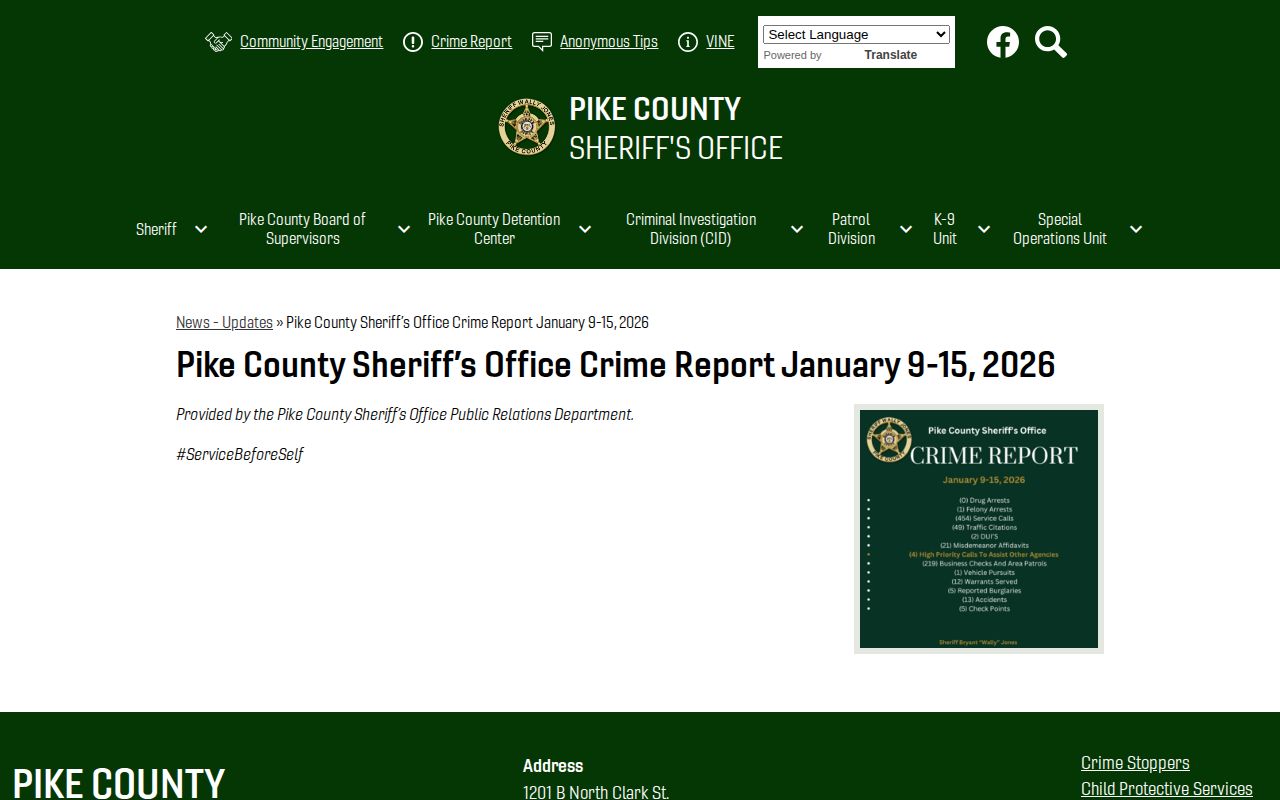
Stick to the facts the report actually gives you. A narrative might name an agency. It might describe alleged conduct, list a location, or attach a charge label. It may say nothing about a booking number, bond amount, release, court date, current facility, or photo source. When a report serves as your lead, note the article title, the exact link, and the date window. That way you can cite it later.
How Pike County News Gets Photos
No verified Pike County policy puts every booking photograph online. None requires handing one to every newsroom. An image attached to a sheriff report might be a public-relations graphic or an agency-supplied photo. A television segment could use law enforcement footage, a file image, surveillance material, or something else entirely. The caption and the credit line, not the story topic, tell you what the picture is. Mississippi’s Public Records Act can make an agency-held photograph a record you can request. Exemptions, redaction, and agency procedure still apply. The law does not force publication on a roster. It does not obligate a newsroom to run the image either. If you need a photo tied to a specific person, ask the originating agency for the record and whether it can be released. The countywide booking-record and custody routes spell out how a records request differs from a present-custody check.
From Pike County Story to Record
A story pays off when you chase it to the office holding the actual record. Start with the agency and the event date named in the report. Keep three things separate from there: who is in custody now, the booking record itself, and the court outcome. Pike County has no verified official live roster with public result fields. The detention phone line and VINE give a more dependable current-status answer than a generic web search.
- Save the article link, date, and named agency. Note whether it identifies an arrest, a court hearing, or an investigation.
- Check the sheriff’s official archive for its own report if the event involved deputies or county detention.
- Call the originating agency or Pike County Detention Center at (601) 783-2324 to ask about current county custody, release, or transfer.
- Use Mississippi VINE for custody-status notification where a participating record is available. VINE is not a photo source.
- Request the booking or incident record from the agency that created it, then use the proper clerk or court system for the later disposition.
Do not assume a name in a McComb article means a trip to county detention. The city may hold its own processing records. In another case the originator could be Magnolia, Summit, the sheriff’s office, or a state agency. Whoever makes the arrest sets the first record path.
Pike County City Coverage Patterns
Each Pike County city leans on its own outlets. McComb gets steady coverage from the Enterprise-Journal. Regional reports fill the gaps now and then. Magnolia has the clearest local channel in the Magnolia Gazette. Summit is different. No verified city-specific mugshot publisher exists there, so the Gazette and regional outlets pick up Summit stories only when the incident is big enough. Across all three cities, coverage follows events, not any daily booking schedule.
The sheriff's public-relations archive casts a wider net. It covers McComb, Magnolia, Summit, interstate spots, and rural Pike whenever deputies take part. McComb's police divisions also describe an E-911 service area reaching into county communities. One arrest can generate a municipal report, a county detention question, and a sheriff release at the same time. No single source holds the whole picture. For agency-by-agency paths, see McComb Busted Mugshots or use the city links in the navigation. When a regional story names a city, weigh the agency and custody details in the official record over the dateline.
Pike County Multi-Agency Stories
Pike County news reports rarely come from just one office. McComb Police runs an E-911 service area covering the city plus nearby county communities. The Sheriff's Office handles county detention and keeps its own public-relations archive. One incident can leave a paper trail in several places at once.
A municipal report, a sheriff release, a custody question, and a court file might all describe the same arrest. None of them is the full record alone. Start with the agency and the date named in the article. Then contact that office and ask whether it made the arrest or merely assisted. That one question keeps you from mistaking a headline for a booking history. It also separates the incident report from present custody and the court's eventual disposition.
Pike County Secondary Source Limits
Only one Pike-local commercial directory checks out: Mugshots.com's Pike County path. Treat it carefully. It is unofficial and stocked with historical entries. It is nothing like a current county roster. Spotting an old public appearance there can be useful. Still, confirm every name, date, charge, and image with the sheriff, city police, a court, or MDOC before trusting it. No verified Pike County page exists for RecentlyBooked, Busted Newspaper, Arrests.org, or Mugshots.zone.
Watch for wrong-state matches, a real hazard here. Pike County, Alabama pages are not Pike County, Mississippi sources. A guessed county URL proves nothing about coverage either. The same caution applies to generic jail-reference pages that claim roster or photo policies without any verified official Pike result behind them.
Pike County Court Outcome Sources
The trail from news story to record ends at the courthouse, not the headline. Pike County splits matters among Justice Court, County/Youth Court, Circuit Court, and McComb's municipal processes. The Circuit Clerk keeps the criminal trial-docket records. The online case search offers filters for party, filing, disposition, docket, and case type. Check the current access terms before relying on it.
Word choice matters in these records. Arrested, booked, and charged describe steps an agency took. Dismissed, not guilty, nolle prosequi, convicted, sentenced, and expunged describe what a court later decided. Use the first set for agency and news reports. Save the second set for cases where the court record itself supports it.